
Successful currency trading starts with discipline, structure, and control. Forex risk management stands at the center of long-term performance, since price movement alone never determines results. You control exposure, execution, and behavior, which directly shape account survival.
Retail traders often focus on entries and indicators, yet losses usually come from poor sizing and emotional reactions. A structured framework protects capital during drawdowns and supports steady growth during favorable market phases, even when volatility rises.
This guide focuses on practical risk control methods you apply immediately to strengthen consistency and confidence!
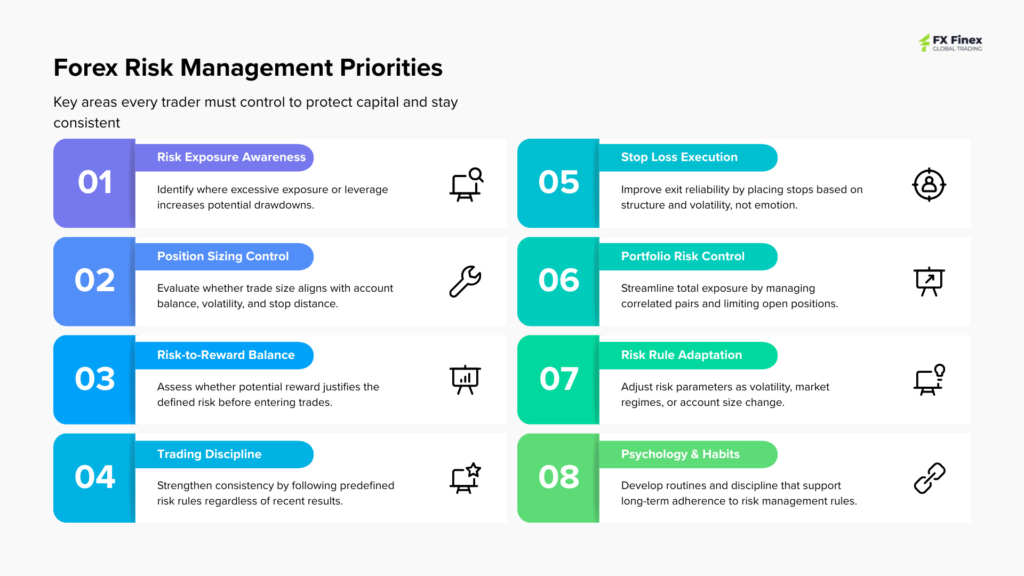
Understanding Risk in the Forex Market
Foreign exchange markets operate twenty-four hours per day with deep liquidity and leverage. These conditions increase opportunity while raising exposure. Risk reflects uncertainty around outcomes, not loss itself, since uncertainty exists in every position you open.
Central bank policy shifts often reshape volatility across major pairs. Decisions from the Federal Reserve and the European Central Bank influence interest rate expectations, which affect trend strength, range behavior, and intraday price swings.
Risk exposure grows when leverage exceeds account tolerance. Traders who ignore volatility context often oversize positions. Structured limits align trade size with account equity, average range, and time horizon.
Warning: Ignoring volatility changes during macro announcements increases drawdown risk.
Position Sizing as a Core Skill
Position sizing defines how much capital you place at risk on each trade. This decision matters more than entry accuracy. Consistent sizing keeps losses small while allowing profits to compound across multiple trades.
Many professionals risk one percent or less per position. This approach supports longevity during losing streaks. Position size depends on account balance, stop distance, and pair volatility, not conviction level or recent performance.
The following sizing principles support consistent execution across market conditions:
- Fixed percentage risk per trade aligned with account equity
- Smaller exposure during high volatility sessions
- Consistent sizing rules across all currency pairs
Applying these principles reduces emotional pressure. You focus on execution quality instead of outcome. Losses feel manageable, which improves discipline across long trading periods.
Tip: Calculate position size before every entry, not after signal confirmation.
The Role of Stop Loss Placement
Stop loss orders define exit points when the price invalidates your setup. Placement reflects market structure rather than arbitrary pip values. Logical stops align with support, resistance, or volatility boundaries.
Traders often place stops too tight, leading to premature exits. Others place them too wide, increasing risk without improving probability. Balanced placement uses recent highs, lows, or average range to define invalidation levels.
Consider these structured stop loss guidelines:
- Place stops beyond the technical structure, not inside the noise
- Adjust distance based on pair volatility metrics
- Avoid moving stops without a technical justification
Proper stops support consistent risk profiles across trades. They also reduce emotional interference during open positions, since exit rules remain clear from the start.
Alert: Moving stops without structure often increases losses over time.
Managing Risk Across Multiple Trades
Single trades matter less than a series of outcomes. Portfolio-level control limits total exposure across correlated pairs. Holding multiple USD positions magnifies risk even if each trade follows sizing rules.
Correlation awareness helps manage aggregate drawdown. Traders track exposure by currency rather than by individual setups. This approach prevents hidden concentration during trending markets.
Forex risk management appears again at this portfolio level, where discipline protects capital during prolonged directional moves. Managing total exposure strengthens long-term consistency across varying market regimes.
The table below highlights common exposure control techniques:
| Risk Control Method | Purpose | Practical Effect |
| Currency exposure limits | Prevent concentration | Reduces correlated losses |
| Maximum open trades | Control activity | Limits overtrading |
| Daily loss cap | Protect equity | Stops emotional spirals |
These controls create structure beyond individual trades. They reduce stress and support consistent decision making across active sessions.
Notice Portfolio limits matter most during strong macro driven trends.
Trading Psychology and Risk Discipline
Risk control fails without psychological discipline. Emotional reactions often override predefined rules after wins or losses. Fear tightens stops, while overconfidence increases size.
Structured routines reduce emotional influence. Pre trade checklists, written rules, and journaling support objective execution. You trade your plan, not recent outcomes.
Adopt these habits to strengthen discipline:
- Review risk parameters before session start
- Journal deviations from sizing or stop rules
- Pause trading after reaching daily loss limits
These habits reinforce accountability. Over time, consistent behavior improves confidence and performance stability.
Note Discipline improves results more than strategy changes.
Wrapping Up
Long-term trading success depends on capital protection more than prediction accuracy. Forex risk management provides the framework that keeps traders active through losing streaks and profitable during favorable cycles. Structure, discipline, and consistency define sustainable performance.