
Many beginners lose control at execution, even when the analysis looks correct. Order types in trading define how trades enter and exit the market, which directly affects price, risk, and emotional pressure. Understanding order mechanics helps beginners avoid slippage, poor fills, and impulsive decisions during fast market movement.
Without clarity on order types, beginners often click buy or sell without intention. This leads to confusion when price fills differ from expectations. Learning how each order works creates precision, improves discipline, and supports consistent execution across different market conditions and instruments.
This guide explains trading order types clearly so beginners can execute trades with control and confidence:
What an Order Type Really Is
An order type instructs the broker how to execute a trade. It defines when and at what price you enter or exit the market. Order types control execution behavior, not market direction. Beginners who understand this distinction avoid blaming strategies for execution errors caused by improper order selection.
Order types matter most during volatility. Fast markets punish unclear execution. Choosing the right order aligns execution with intention, whether prioritizing speed, price control, or protection against adverse movement.
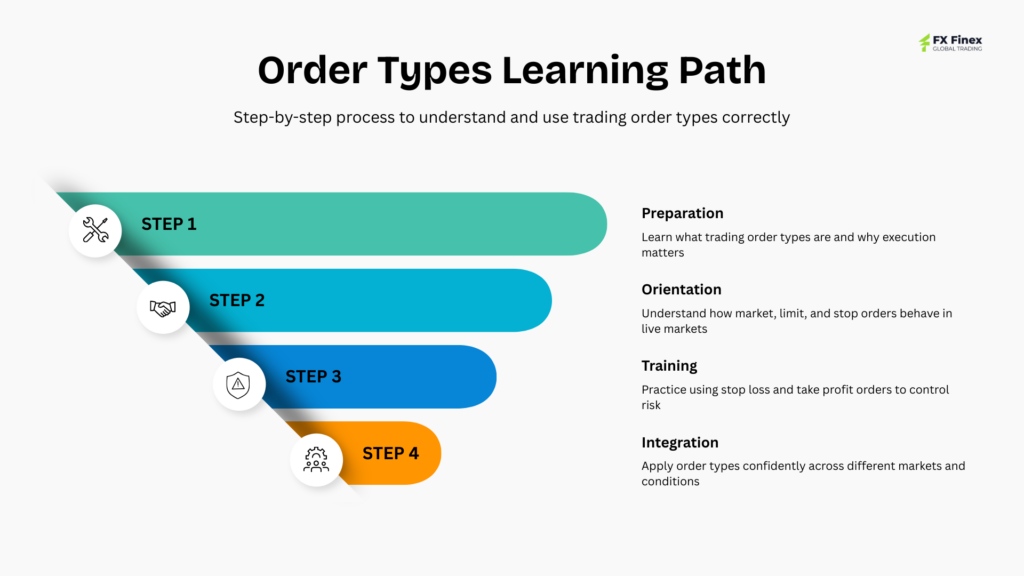
Market Orders Explained Simply
A market order executes immediately at the best available price. It prioritizes speed over price accuracy. Beginners often use market orders because they feel simple, but price may differ slightly from what appears on the chart, especially during high volatility or low liquidity.
Market orders suit situations where entry matters more than exact price. They work best in liquid markets during active sessions. Beginners should understand that execution certainty comes at the cost of price control.
Warning: Market orders increase slippage risk during volatile conditions.
Limit Orders and Price Control
A limit order executes only at a specified price or better. It gives full price control but no execution guarantee. Beginners use limit orders to avoid chasing price and to enter at planned levels such as support or resistance zones.
Limit orders require patience. Price may never reach the level. This outcome is normal and preferable to forced entries at poor prices. Limit orders support discipline by aligning execution with analysis rather than emotion.
Stop Orders and Trade Protection
Stop orders trigger execution once price reaches a specified level. They are commonly used for stop losses or breakout entries. Stop orders activate only when price confirms movement beyond a level, which helps manage risk or momentum based strategies.
Beginners must understand that stop orders become market orders once triggered. This means execution price may differ slightly from the stop level during fast moves. Stops define protection, not guaranteed prices.
Alert: Stop orders do not guarantee exact exit prices.
Stop Loss Orders and Risk Definition
A stop loss order exits a trade when price reaches a predefined invalidation level. It defines maximum loss before entry, which supports emotional control and account protection. Beginners who trade without stop losses expose themselves to uncontrolled drawdowns.
Stop loss placement should reflect market structure rather than comfort. Logical placement improves consistency and reduces emotional interference. Stops exist to protect capital, not to avoid being wrong.
Take Profit Orders and Exit Planning
A take profit order closes a trade at a predefined favorable price. It removes emotion from exits by defining success criteria before entry. Beginners often struggle with exits due to greed or hesitation. Take profit orders provide structure.
Not all strategies require fixed take profits. Some traders exit manually based on structure. Beginners benefit from predefined targets early to build discipline and consistency during learning phases.
Pending Orders Versus Instant Execution
Pending orders include limit and stop orders placed in advance. Instant execution uses market orders at the moment of decision. Pending orders support planning and patience. Instant execution supports responsiveness.
Beginners often benefit from pending orders because they reduce impulsive behavior. Planning entries ahead of time improves execution quality and reduces emotional pressure during live price movement.
Note: Planned orders reduce emotional execution errors.
Using Order Types Across Markets
Order behavior remains consistent across forex, stocks, indices, and commodities, though execution quality varies with liquidity and trading hours. Stocks may gap between sessions. Indices move strongly during data releases. Forex trades continuously with fewer gaps.
Beginners must adjust expectations. Order types work the same, but market structure influences outcomes. Understanding this prevents confusion and misinterpretation of fills.
Common Beginner Mistakes With Order Types
Many beginners confuse stop orders with limit orders. Others place stops too close or use market orders during illiquid periods. Some beginners cancel protective orders due to fear, removing risk control entirely.
These mistakes stem from incomplete understanding. Reviewing order behavior through practice and journaling improves execution skill and confidence over time.
Practicing Order Execution Safely
Beginners should practice order placement in demo accounts or with very small size. Focus on understanding how orders fill, not on profit. Observe slippage, partial fills, and missed entries.
Review each execution afterward. Ask whether the chosen order matched the intention. This feedback builds precision and reduces costly errors in live trading.
Wrapping Up
Understanding order types in trading gives beginners control over execution, risk, and discipline. Market, limit, stop, and protective orders each serve specific purposes. When chosen intentionally and practiced consistently, order types transform analysis into structured action and support steady progress across all trading markets.