
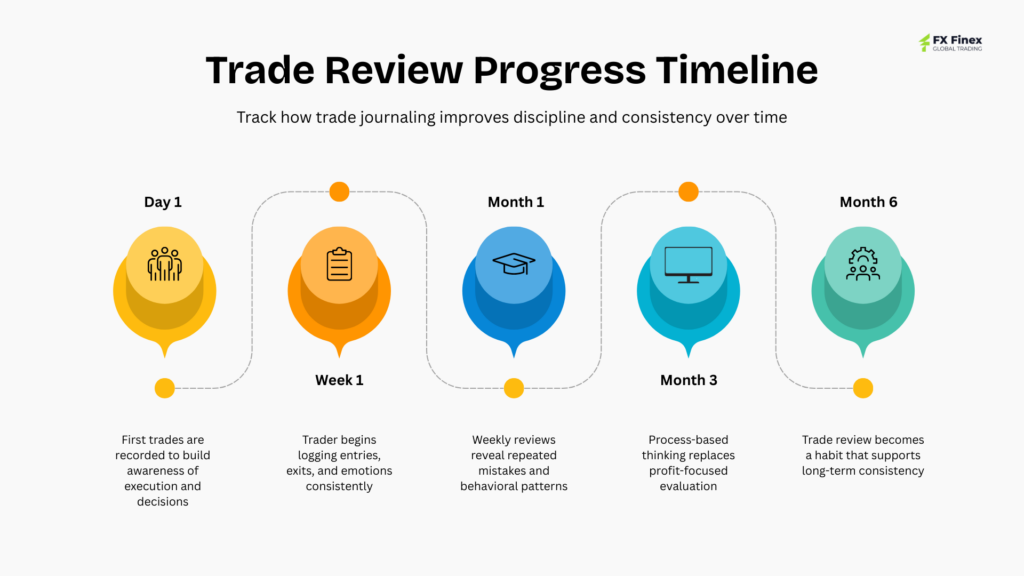
Most beginners focus entirely on entering trades and ignore what happens afterward. A trading journal for beginners creates a feedback loop that turns every trade into usable information. Tracking and reviewing trades helps you understand behavior, execution quality, and decision patterns that charts alone never reveal.
Without review, mistakes repeat silently and progress stalls. Reviewing trades builds awareness by showing whether rules were followed and where emotional decisions appeared. This process shifts focus from profit chasing toward steady improvement through observation, discipline, and measurable behavior over time.
This guide explains how beginners track and review trades in a simple, structured, and practical way:
Why Tracking Trades Matters
Tracking trades matters because memory distorts reality. After wins or losses, beginners often remember emotions rather than facts. A written record removes bias and replaces assumptions with evidence. This clarity allows you to evaluate decisions objectively instead of guessing why results fluctuate.
Trade tracking also reveals patterns over time. You may notice consistent mistakes such as entering late, ignoring stops, or overtrading certain sessions. Identifying these patterns creates specific improvement targets rather than vague frustration or self-doubt.
What a Trading Journal Includes
A trading journal records both technical and behavioral information. Price levels matter, but mindset and execution matter just as much. Beginners often journal too little or too much. Balance creates usefulness.
A good journal captures the decision process from entry to exit. It focuses on clarity rather than complexity. The goal remains understanding behavior, not creating perfect documentation.
A beginner trading journal usually includes:
- Instrument and timeframe traded
- Entry, stop, and exit levels
- Reason for entry and exit
- Emotional state before and after
Recording these details builds accountability and awareness over time.
How to Record Trades Consistently
Consistency matters more than format. Some traders use spreadsheets. Others use notebooks or journal software. Beginners should choose a method that feels easy enough to maintain daily without resistance.
Record trades immediately after closing them. Waiting leads to forgotten details and emotional distortion. Write objectively without judgment. Describe what happened rather than why it felt good or bad.
Tip: Record facts first, reflections second.
Reviewing Trades the Right Way
Reviewing trades means analyzing behavior, not blaming outcomes. Beginners often review only losing trades and ignore winners. Both provide valuable information. Winning trades reveal what worked. Losing trades reveal what failed.
Schedule review sessions weekly or biweekly rather than after every trade. This spacing reduces emotional influence and reveals patterns across multiple trades. Focus on rule adherence rather than profit totals.
An effective trade review process focuses on:
- Rule compliance
- Entry timing quality
- Stop placement logic
- Emotional interference
This approach builds skill through evidence rather than emotion.
Separating Process From Results
Results fluctuate due to probability. Process remains controllable. Beginners who judge success by profit alone often break rules under pressure. Reviewing process keeps improvement stable even during losing streaks.
A profitable trade taken without rules still counts as a mistake. A losing trade taken according to plan counts as correct execution. This distinction protects discipline and long-term development.
Process focus builds consistency without emotional swings.
Using Data to Improve Performance
Trade journals create data. Over time, this data reveals strengths and weaknesses. You may find certain setups perform better or certain sessions cause losses. Data replaces opinion with measurable evidence.
Beginners should keep the analysis simple. Focus on win rate, average loss size, and rule adherence. Avoid complex statistics early. Clarity matters more than sophistication.
The table below shows the simple journal metrics beginner’s track:
| Metric | Purpose | Insight |
| Win rate | Outcome balance | Expectation management |
| Average loss | Risk control | Discipline check |
| Rule adherence | Behavior quality | Consistency |
Emotional Awareness Through Journaling
Emotions influence every trade. Journaling makes them visible. Beginners often notice repeated emotions before mistakes, such as fear near stops or overconfidence after wins.
Write emotions briefly and objectively. Avoid storytelling. Over time, emotional patterns appear clearly. Awareness reduces their influence because reactions become predictable rather than surprising.
This awareness supports calmer execution across changing market conditions.
Common Beginner Mistakes in Trade Review
Many beginners stop journaling after a few weeks. Others write too much without reviewing. Some only have journal losses. These habits reduce effectiveness. Another mistake involves changing strategies based on small sample sizes. Review requires patience. Patterns emerge over dozens of trades, not three or four.
Warning: Concluding small samples creates false confidence.
How Trade Review Improves Discipline
Trade review reinforces accountability. Knowing that trades will be reviewed discourages impulsive decisions. This awareness alone improves discipline during live trading.
Review also separates emotion from execution. Seeing mistakes written clearly reduces self-criticism and supports objective correction. Discipline grows through remembered evidence rather than motivation. Structure replaces impulse when review becomes routine.
Linking Trade Review to a Trading Plan
A trading plan defines rules. A journal measures adherence. Together, they form a complete improvement loop. Beginners who journal without a plan lack benchmarks. Beginners who plan without review lack feedback.
Review sessions should reference plan rules directly. Identify where execution matched rules and where it deviated. This alignment transforms review into targeted improvement rather than general reflection.
Process improvement accelerates when plan and journal work together.
Long-Term Benefits of Trade Tracking
Over time, a journal becomes a personal database. You understand how you trade under pressure, success, and failure. This self knowledge outperforms copying external strategies.
Beginners who journal early avoid repeating mistakes later. Progress becomes visible through improved behavior, not just account balance. Confidence grows from evidence rather than hope. Learning stabilizes through documentation.
Wrapping Up
Using a trading journal for beginners turns random outcomes into structured feedback. Tracking and reviewing trades builds awareness, discipline, and measurable improvement. By focusing on behavior, process, and evidence, beginners create a foundation for steady development and long-term consistency across all market conditions.