
Entering digital asset markets without preparation leads to fast losses. Crypto trading basics give beginners a clear framework for understanding price movement, volatility, and execution. Strong foundations reduce emotional mistakes during early trades.
Crypto markets attract new traders due to accessibility and large price swings. These same features increase risk. Learning how the market operates builds confidence and supports controlled decision-making from the start.
This guide explains the essential concepts you need before placing your first crypto trade!
What Crypto Trading Involves
Crypto trading involves buying and selling digital assets through online exchanges. Prices fluctuate based on supply, demand, news, and market sentiment. Unlike traditional markets, crypto trades operate continuously without closing hours.
This nonstop structure creates frequent price movement. Beginners benefit from understanding that constant availability increases opportunity and emotional pressure. Structure and discipline matter more than speed.
Market access remains simple, yet risk remains high. Education protects capital during early learning stages.
Warning: Continuous markets increase overtrading risk for beginners.
Understanding Crypto Market Volatility
Volatility refers to how quickly and widely prices move. Crypto assets experience larger swings than most forex or stock instruments. Sudden moves occur during news releases, social media trends, or liquidity shifts.
Beginners often confuse volatility with opportunity alone. Large swings increase both profit potential and loss speed. Controlled position sizing and stop losses reduce downside exposure.
Volatility management starts with awareness and preparation:
- Expect wider price swings than traditional markets
- Reduce position size during sharp movements
- Avoid trading during emotional market spikes
Understanding volatility helps you plan rather than react. Calm execution improves consistency over time.
Alert: Trading during extreme volatility increases execution errors.
Choosing a Crypto Exchange
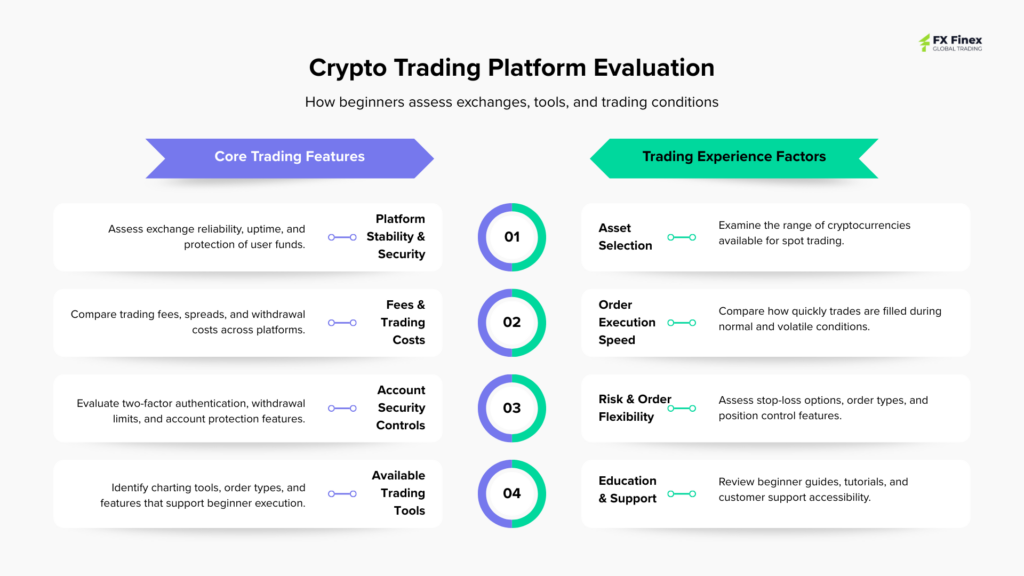
A crypto exchange acts as your trading venue. Exchanges differ in fees, security standards, and available assets. Beginners benefit from using established platforms with strong liquidity and transparent pricing.
Security matters more than variety. Two-factor authentication and withdrawal controls protect funds. Liquidity reduces slippage and improves execution quality.
Exchange selection affects costs and safety. Choose simplicity and reliability over novelty.
Spot Trading Versus Leveraged Trading
Spot trading involves buying and selling the actual asset. Leveraged trading uses borrowed funds to increase position size. Beginners benefit from starting with spot trading due to lower risk.
Leverage amplifies gains and losses equally. Many new traders underestimate drawdowns caused by leverage. Learning market behavior first builds skill before increasing exposure.
The table below compares beginner trading approaches:
| Trading Type | Risk Level | Beginner Suitability |
| Spot trading | Lower | High |
| Leveraged trading | Higher | Low |
Starting simple protects capital. Complexity adds pressure without improving learning speed.
Risk Control for Beginner Crypto Traders
Risk control defines how much you lose when a trade fails. Beginners benefit from risking a small percentage of their account balance per trade. This approach supports survival during losing streaks.
Always define a stop loss before entering. Accept losses as part of trading rather than personal failure. Discipline improves faster than prediction skill.
Use these basic risk rules when trading crypto:
- Risk is one percent or less per trade
- Place stop losses at logical levels
- Limit the number of open positions
Clear limits reduce emotional decisions. Structure keeps learning steady and controlled.
Note: Small losses protect confidence and account longevity.
Wrapping Up
Learning crypto trading basics helps beginners navigate volatility with structure and confidence. Understanding market behavior, exchange choice, and risk control supports steady progress. Simple rules applied consistently form the foundation for long-term development.