
Most beginners lose money not because markets feel impossible, but because they repeat avoidable errors. Beginner trading mistakes usually come from poor habits, emotional decisions, and a lack of structure rather than weak analysis. Understanding these mistakes early helps you protect capital, improve discipline, and progress with fewer setbacks during the learning phase.
Trading exposes emotions quickly because money stays at risk in uncertain conditions. Without clear rules, beginners react to fear, excitement, and frustration. Recognizing where these reactions cause damage allows you to replace impulsive behavior with deliberate, repeatable actions over time.
This article breaks down the most common beginner mistakes and explains how to avoid them clearly and practically:
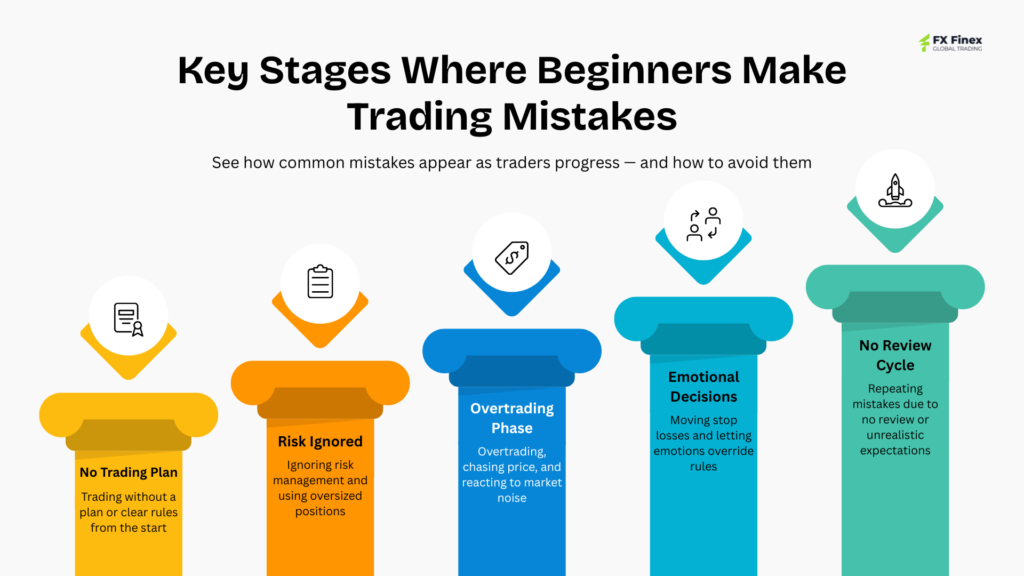
Trading Without a Plan
Many beginners enter markets without a defined plan and rely on instinct or signals. This leads to random entries, inconsistent sizing, and emotional exits. Without a plan, you cannot evaluate performance because decisions change constantly based on mood or recent outcomes.
A trading plan defines what you trade, when you trade, and how you manage risk. It removes guesswork and creates accountability. Beginners who trade without structure often confuse luck with skill and repeat mistakes without understanding why results vary.
Ignoring Risk Management
Ignoring risk management causes rapid drawdowns even when analysis feels correct. Beginners often focus on winning trades and underestimate losses. Oversized positions magnify emotions and lead to panic decisions during normal market fluctuations.
Risk management defines survival. Fixed risk per trade, clear stop losses, and exposure limits keep losses manageable. Without these rules, one bad trade or short losing streak often wipes out weeks of progress.
Warning: Large position sizes amplify emotional mistakes.
Overtrading and Excessive Screen Time
Overtrading occurs when beginners trade too frequently without valid setups. Constant chart watching increases the urge to act. This behavior leads to low-quality trades driven by boredom rather than opportunity.
Markets do not offer constant high probability setups. Learning to wait builds discipline. Fewer trades with a clear structure outperform frequent impulsive trades over time. Reducing screen time improves patience and decision quality.
Chasing Price and Fear of Missing Out
Fear of missing out pushes beginners to enter trades late after the price has already moved. Chasing often results in poor entries, wide stops, and unfavorable risk-to-reward. Emotional urgency replaces planning during fast market moves.
Price movement does not equal opportunity. Waiting for the price to reach the planned areas improves consistency. Accepting missed trades as normal prevents emotional spirals and protects discipline.
Moving Stop Losses Emotionally
Beginners often move stop losses when the price approaches them. This behavior transforms small planned losses into large unplanned ones. Fear drives these decisions, not logic or structure.
Stop losses exist to define invalidation. When the price reaches that point, the trade idea failed. Respecting stops protects capital and mental clarity. Moving stops without structural reasons removes risk control entirely.
Alert: Removing stops exposes accounts to uncontrolled losses.
Changing Strategies Too Often
Many beginners abandon strategies after a few losses and search for new systems. This prevents learning and creates confusion. Every strategy experiences losing periods due to probability.
Consistency allows meaningful evaluation. Sticking to one approach long enough reveals strengths and weaknesses. Constant switching resets the learning curve and delays improvement. Patience supports progress more than novelty.
Letting Emotions Control Decisions
Fear, greed, and frustration influence beginners more than analysis. Emotional decisions include revenge trading, increasing size after losses, and breaking rules after wins. These behaviors often compound losses quickly.
Emotions never disappear. Structure limits their impact. Predefined rules, fixed risk, and limited trade frequency reduce emotional interference and support stable execution across different market conditions.
Trading Without Review or Journaling
Without review, mistakes repeat unnoticed. Many beginners trade actively but never analyze their behavior or decisions afterward. This prevents improvement because errors remain invisible.
Journaling highlights patterns in execution, emotion, and rule adherence. Reviewing trades objectively turns losses into feedback. Progress accelerates when reflection becomes part of the routine.
An effective beginner journal tracks:
- Entry and exit reasons
- Risk and position size
- Emotional state during trades
Expecting Fast or Consistent Profits
Unrealistic expectations cause frustration and poor decisions. Beginners often expect steady profits early and feel discouraged after losses. This mindset increases emotional pressure and leads to rule-breaking.
Trading involves uncertainty and variance. Losses occur even with correct decisions. Accepting this reality reduces stress and improves discipline. Progress focuses on behavior quality rather than short-term outcomes.
Comparing Results With Others
Comparing results with other traders creates unnecessary pressure. Everyone trades different markets, timeframes, and risk levels. Comparison shifts focus from personal development to external validation.
Improvement comes from refining your own process. Tracking personal progress provides meaningful feedback. External comparisons often distort expectations and increase emotional instability.
Wrapping Up
Avoiding beginner trading mistakes helps protect capital and accelerates learning. Most errors come from lack of structure, emotional reactions, and unrealistic expectations. By trading with a plan, managing risk, reviewing behavior, and focusing on process rather than outcomes, beginners build habits that support steady improvement and long-term participation in the markets.