
Understanding market direction feels difficult when you focus on single companies only. Stock indices trading helps beginners see the broader picture by tracking groups of stocks instead of isolated price moves. This approach reduces noise and improves decision clarity during uncertain market conditions.
New traders often struggle with conflicting signals from individual stocks. Indices solve this issue by showing collective performance across sectors and company sizes. Learning how indices function builds confidence and supports more consistent analysis from the beginning.
This guide explains how indices work and why traders rely on them for structure and stability!
What a Stock Index Represents
A stock index measures the performance of a group of stocks selected using defined criteria. These stocks usually represent a market, sector, or economy. When index values rise, most underlying stocks show strength. When index values fall, weakness spreads across the group.
The stock market allows companies to raise capital by selling ownership shares to investors. When you buy a stock, you own part of that company, and index movement reflects combined performance, investor expectations, and economic outlook across many businesses at once.
Market representation makes indices valuable. They summarize broad trends without requiring analysis of every individual stock.
Note: Indices reflect collective behavior, not single company events.
Popular Stock Indices Beginners Should Know
Several major indices dominate global markets and trading activity. These indices differ in composition, weighting, and focus. Beginners benefit from learning a few widely followed benchmarks before exploring niche markets.
In the United States, widely tracked indices include the S&P 500, the Dow Jones Industrial Average, and the Nasdaq Composite. Each reflects different segments of the economy and investor behavior.
The most common indices beginners encounter include:
- Broad market indices tracking large companies
- Technology-focused indices emphasizing growth stocks
- Industrial indices highlighting established firms
Learning these benchmarks helps beginners interpret news, sentiment, and market strength more effectively.
How Stock Indices Are Calculated
Index values depend on calculation methods. Some indices weight companies by market capitalization. Others weigh by stock price. These methods affect how individual stocks influence index movement.
Market capitalization-weighted indices give larger companies greater influence. Price-weighted indices give higher-priced stocks more impact. Understanding this distinction prevents confusion when a single stock drives index movement.
Index mechanics explain why indices react differently to the same news. This knowledge improves interpretation and reduces surprise during volatile sessions.
Why Traders Use Stock Indices
Traders use indices to trade overall market direction rather than company specific events. This approach reduces earnings risk and headline exposure. Indices often move smoothly than individual stocks due to diversification.
Index trading suits beginners seeking simplicity. Fewer instruments require monitoring. Broader exposure reduces sudden price shocks caused by company announcements.
Traders rely on indices for several practical reasons:
- Broader exposure with fewer positions
- Reduced impact from single stock news
- Clearer trend identification
This structure helps beginners focus on execution quality rather than constant analysis.
Tip: Indices often trend more cleanly than individual stocks.
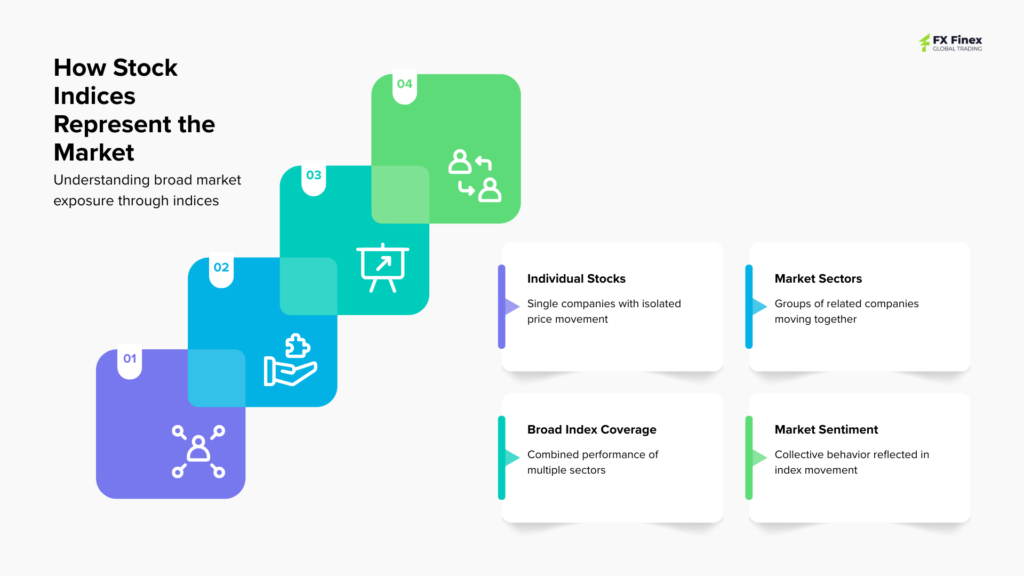
Stock Indices Versus Individual Stocks
Indices and stocks behave differently under the same conditions. Individual stocks react sharply to earnings, management changes, or sector news. Indices respond to aggregate performance and macroeconomic forces.
Beginners often feel overwhelmed by stock-specific volatility. Indices reduce this pressure by spreading risk across many companies. This results in steadier movement and fewer unpredictable gaps.
Instrument choice affects stress and consistency. Indices often support calmer decision-making for newer traders.
How Beginners Trade Stock Indices
Beginners usually access indices through derivatives such as CFDs, futures, or ETFs. These instruments track index value without requiring ownership of every underlying stock. This access simplifies participation. Most beginners start with CFDs or ETFs due to flexibility and smaller capital requirements. Futures involve higher complexity and contract specifications.
The table below compares common index trading instruments:
| Instrument | Complexity | Beginner Suitability |
| CFDs | Lower | Higher |
| ETFs | Medium | Higher |
| Futures | Higher | Lower |
Choosing the right instrument improves learning efficiency and reduces avoidable errors.
Market Sessions and Index Volatility
Index volatility varies throughout the trading day. Opening hours often show increased movement due to order flow and news digestion. Closing hours reflect position adjustments and institutional activity.
Economic data releases also influence indices. Employment reports, inflation data, and interest rate decisions affect broad market sentiment. Beginners benefit from trading during active sessions with clear direction.
Session awareness helps manage expectations and execution quality.
Alert: Low liquidity periods increase slippage and false signals.
Risk Management for Index Trading
Risk management remains essential even with diversified instruments. Indices still experience sharp moves during economic shocks or policy changes. Beginners benefit from structured exposure limits.
Use predefined position sizes and stop losses. Avoid overtrading multiple indices simultaneously. Focus on quality setups aligned with broader trend direction.
Simple index risk rules support beginner discipline:
- Risk a small fixed percentage per trade
- Limit the number of open index positions
- Avoid trading during major announcements
These rules protect capital and emotional balance during learning stages.
How Stock Indices Trading Fits Long-Term Growth
Stock indices trading offers beginners a balanced entry into markets. Broader exposure reduces emotional extremes and supports consistent practice. Over time, this builds confidence and skill.
Indices also help beginners understand economic cycles. Bull markets lift most indices. Bear markets pressure them broadly. This clarity improves market awareness and strategic thinking. Learning progression improves when tools reduce unnecessary complexity.
Notice: Simpler instruments often accelerate skill development.
Wrapping Up
Learning stock indices trading gives beginners a structured way to understand market direction without focusing on individual stocks. Indices reflect collective behavior driven by economic forces and investor sentiment. Combined with disciplined risk control, this approach supports steady development and long-term trading confidence.