
Many beginners struggle not because of strategy quality but because they trade on unsuitable charts. Trading timeframes define how often you trade, how long positions stay open, and how much emotional pressure you face. Choosing the right timeframe creates alignment between your personality, schedule, and risk tolerance, which improves consistency and decision quality.
New traders often jump between timeframes searching for better results. This creates confusion and conflicting signals. A clear timeframe choice simplifies analysis, reduces overtrading, and helps you build skill through repetition instead of constant adjustment.
This guide explains how beginners choose trading timeframes logically and apply them with structure and discipline:
What a Trading Timeframe Really Means
A trading timeframe represents the period each candlestick or bar covers on a chart, such as five minutes, one hour, or one day. It determines how much price data you analyze at once and how frequently trading decisions occur. Shorter timeframes show more detail and noise, while higher timeframes show clearer structure and slower movement.
Timeframe choice affects stress, screen time, and reaction speed. Beginners who understand this avoid forcing themselves into styles that conflict with their availability or temperament, which often leads to emotional mistakes and inconsistent execution.
Why Timeframe Choice Matters for Beginners
Timeframes influence everything from stop size to trade frequency. Lower timeframes require rapid decisions and constant monitoring. Higher timeframes allow more time for analysis and decision making. Many beginners fail because they choose timeframes that demand skills they have not yet developed.
A mismatch between timeframe and lifestyle creates pressure. Traders with limited screen time struggle on fast charts. Those who dislike waiting struggle on slow charts. Choosing correctly improves discipline and reduces frustration.
Tip: Match the timeframe speed to your daily availability and patience level.
Common Trading Timeframes Explained
Trading timeframes generally fall into short-term, medium-term, and longer-term categories. Each category suits different personalities and goals. Beginners benefit from understanding these differences before selecting a primary chart.
The most common trading timeframe categories include:
- Short-term charts, such as one to five minutes
- Medium-term charts, such as fifteen minutes to one hour
- Higher timeframes, such as four-hour or daily charts
Each category carries different stress levels, trade frequency, and learning curves. Understanding this prevents unrealistic expectations.
Short-Term Timeframes and Their Challenges
Short-term trading involves frequent decisions and rapid price movement. Charts update constantly, which increases emotional pressure. Beginners often struggle here due to hesitation, overreaction, and poor execution under stress.
Short-term charts amplify noise. False signals appear frequently. Transaction costs also increase due to higher trade frequency. These factors make short-term trading demanding for new traders still learning discipline and structure. This timeframe suits traders with a strong focus, fast decision-making, and high screen availability.
Medium-Term Timeframes for Balanced Trading
Medium-term timeframes offer a balance between detail and clarity. They provide enough signals to practice regularly without overwhelming frequency. Many beginners find this range more manageable during early development.
Charts move more slowly, allowing time to analyze setups and define risk properly. Emotional pressure decreases because decisions do not require instant reactions. Medium-term trading often supports better learning and review quality. This timeframe range suits beginners seeking structure without excessive waiting.
Higher Timeframes and Long-Term Perspective
Higher timeframes move slowly and show broader market structure. Price noise reduces significantly. Trends and key levels become clearer. Beginners benefit from reduced stress and fewer decisions.
Trades last longer, which requires patience. However, decision quality often improves because signals form more cleanly. Higher timeframes also align well with part-time trading schedules.
This approach suits traders who prefer analysis over constant monitoring.
How Timeframes Affect Risk and Stop Size
Timeframes influence stop loss distance and position size. Lower timeframes use tighter stops and larger sizes. Higher timeframes use wider stops and a smaller size. Beginners must understand this relationship to avoid overexposure.
Risk remains consistent when position size adjusts correctly. Ignoring this leads to oversized trades and emotional swings. Proper adjustment keeps losses controlled regardless of the time frame choice. Understanding this relationship improves risk discipline across styles.
Choosing a Timeframe Based on Personality
Personality plays a major role in timeframe selection. Impatient traders struggle with long waits. Calm traders struggle with fast decision-making. Self-awareness helps avoid repeated mistakes.
Beginners should choose timeframes that feel comfortable rather than exciting. Comfort supports discipline. Excitement often leads to impulsive behavior and rule-breaking. Honest self-assessment improves long-term consistency.
Using Multiple Timeframes Correctly
Many traders use more than one timeframe. This approach adds context when done correctly. Beginners often misuse it by jumping randomly between charts. A simple structure works best. Use a higher timeframe to identify trends and key levels. Use a lower timeframe for entries only. Avoid analyzing too many timeframes simultaneously.
Proper multi-timeframe analysis usually follows this structure:
- Higher timeframe for direction
- Middle timeframe for structure
- Lower timeframe for execution
This hierarchy reduces confusion and conflicting signals.
Timeframe Selection and Trading Style
Timeframe choice defines trading style. Scalping uses very short charts. Swing trading uses higher charts. Position trading uses the highest timeframes. Beginners benefit from choosing one style and committing to it.
Switching styles frequently slows learning. Consistency builds skill faster than experimentation. Choose a time frame range and develop competence before expanding. Style clarity supports focused improvement.
Common Beginner Mistakes With Timeframes
Beginners often switch timeframes after losses, believing another chart will work better. This prevents learning and creates inconsistency. Another mistake involves trading too many timeframes simultaneously.
Some beginners choose timeframes based on excitement rather than suitability. This leads to emotional stress and burnout. Awareness of these mistakes helps correct habits early.
Warning: Frequent timeframe switching prevents measurable progress.
Practicing With a Chosen Timeframe
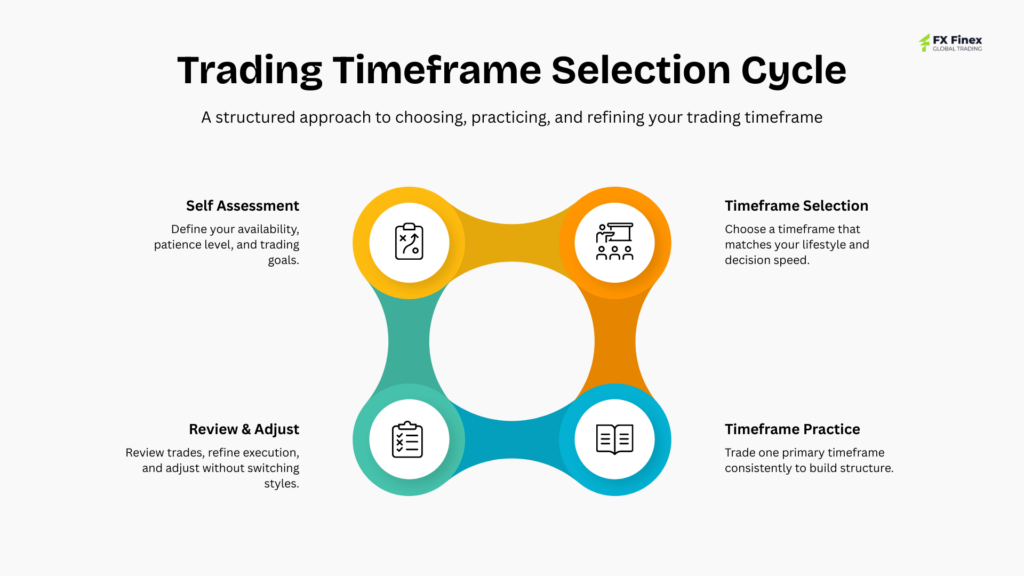
Practice involves repetition over the same timeframe. Mark levels, observe price behavior, and review trades consistently. Over time, pattern recognition improves naturally.
Journaling time frame-specific mistakes helps identify weaknesses. Review whether errors come from execution, patience, or risk management. This feedback loop accelerates learning. Skill grows through focused repetition rather than constant change.
Wrapping Up
Choosing the right trading timeframes helps beginners align strategy, risk, and lifestyle into a workable structure. Timeframes shape stress levels, trade frequency, and decision quality. By selecting a suitable timeframe and committing to it, beginners reduce confusion, improve discipline, and build a foundation for steady long-term development.