
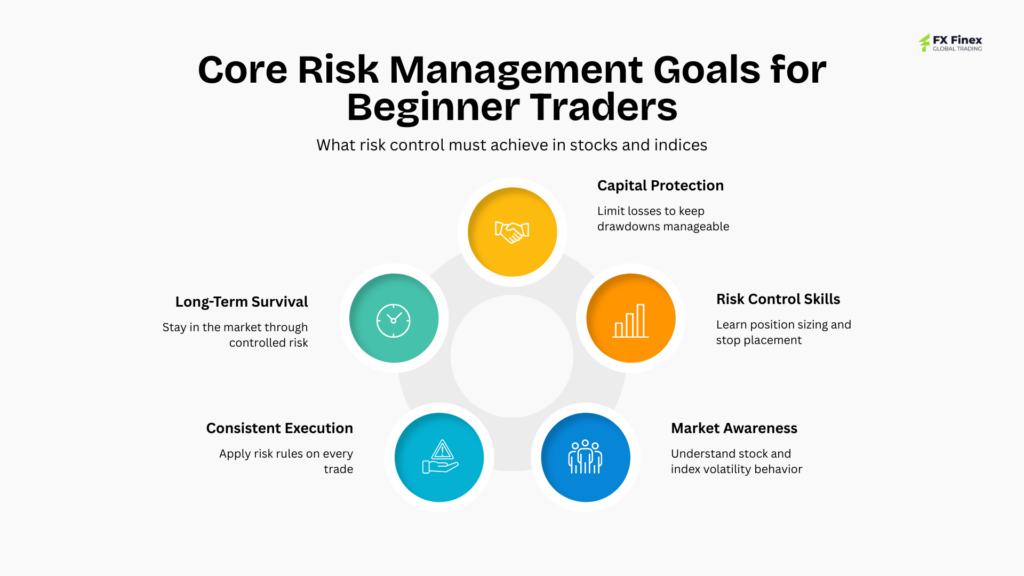
Learning to trade stocks and indices without risk control leads to fast and unnecessary losses. Stock and index risk management focuses on limiting downside rather than chasing profits. Beginners who understand how to control exposure, define losses, and manage positions develop consistency faster and avoid emotional decision-making during volatile market conditions.
Many beginners focus heavily on entries while ignoring what happens when trades go wrong. Losses occur in every strategy. Risk management determines whether those losses remain small and manageable or grow into account-damaging drawdowns that prevent long-term participation in the markets.
This guide explains clear and practical risk management rules every beginner should apply before placing trades!
Why Risk Management Matters More Than Strategy
Most beginner accounts fail due to poor risk control rather than poor analysis. Even accurate trade ideas fail when position size stays too large or exits remain undefined. Risk management ensures that no single trade or short losing streak causes serious damage to account equity during the learning process.
Markets move based on probability, not certainty. Strong trends still experience pullbacks and false breakouts. Risk rules absorb these normal fluctuations and allow traders to stay disciplined rather than abandoning their approach after a few losses.
Note: Risk control determines survival, not trade accuracy.
Understanding Risk in Stocks and Indices
Risk in trading refers to the amount of capital lost when the price moves against your position. Stocks carry company-specific risk related to earnings, guidance, and management changes. Indices carry broader economic risk driven by macro data, interest rates, and investor sentiment across many companies.
Indices generally move smoothly due to diversification, while individual stocks often experience sharper reactions to news. Beginners benefit from recognizing these differences before choosing instruments, since stop placement, position sizing, and exposure limits vary between stocks and indices.
Position Sizing Explained for Beginners
Position sizing defines how much capital you place at risk on each trade. Beginners benefit from risking a fixed small percentage of account equity, often one percent or less. This approach limits drawdowns and prevents emotional reactions during losing streaks, which are inevitable during early development.
Position size depends on stop loss distance rather than conviction. Wider stops require a smaller size, while tighter stops allow a slightly larger size. This calculation removes guesswork and ensures consistency across all trades regardless of market conditions.
Apply these beginner position sizing rules consistently:
- Risk a fixed small percentage per trade
- Calculate size based on stop loss distance
- Use the same rule for stocks and indices
Tip: Decide risk amount before selecting trade size.
Stop Loss Placement for Stocks and Indices
A stop loss defines where you exit when a trade fails. Beginners often avoid stop losses due to fear of being wrong, which leads to much larger losses when the price moves sharply. Proper stop placement aligns with price structure rather than random values or emotional comfort.
Stops should sit beyond recent highs, lows, or clear support and resistance levels. For indices, stops often require more room due to intraday volatility. For stocks, gaps around earnings increase risk and require careful planning.
Warning: Trading without stop losses exposes accounts to rapid drawdowns.
Managing Risk Across Multiple Trades
Risk management extends beyond individual trades. Holding multiple positions within the same sector or economy increases correlation and amplifies losses during market swings. Beginners often underestimate this exposure when opening several trades that appear different but move together.
Limiting the number of open trades improves focus and emotional control. Portfolio level limits prevent overtrading and reduce stress during volatile sessions. Quality setups outperform high trade frequency over time.
The table below shows simple beginner portfolio risk limits:
| Risk Rule | Purpose | Benefit |
| Maximum open trades | Control exposure | Lower volatility |
| Sector diversification | Reduce correlation | Balanced risk |
| Daily loss limit | Emotional control | Discipline |
Differences Between Stock and Index Risk
Stocks react strongly to company-specific events such as earnings releases, guidance updates, or regulatory news. Indices respond more to economic indicators and interest rate expectations. Beginners must adjust risk rules based on these behavioral differences to avoid surprises.
Economic policy decisions from the Federal Reserve often influence index direction broadly, while individual stocks may respond unevenly depending on sector sensitivity. Understanding these dynamics improves execution planning and expectation management.
Trading Around News and Earnings Events
News events increase volatility and unpredictability. Earnings reports often cause overnight price gaps in stocks, while economic data releases create sharp intraday moves in indices. Beginners benefit from avoiding trading during these periods until experience develops.
Waiting for volatility to settle after announcements often provides clearer price structure and safer entry conditions. Trading during news introduces execution risk that overwhelms technical or fundamental analysis for less experienced traders.
Alert: Earnings related gaps often bypass stop losses entirely.
Risk Management and Trading Psychology
Risk rules directly influence psychological stability. When losses remain controlled, emotional pressure decreases. Clear limits prevent revenge trading and impulsive position sizing after losing trades, which commonly damage beginner accounts.
Consistent risk management creates predictable outcomes. Traders focus on execution quality rather than profit or loss from individual trades. Journaling whether risk rules were followed reinforces accountability and highlights behavioral patterns that need correction.
Long-Term Risk Discipline for Sustainable Growth
Risk management remains essential as skill improves and account size grows. Larger positions increase emotional pressure, making rules even more important over time. Beginners who build strong habits early avoid major setbacks later in their trading journey.
Consistent application of risk rules supports gradual improvement. Learning accelerates when losses stay small and manageable. Stability allows traders to refine analysis, execution, and discipline without fear of account ruin.
Wrapping Up
Learning stock and index risk management gives beginners a structured framework for protecting capital while developing skill. Position sizing, stop losses, and exposure limits reduce emotional decisions and prevent large drawdowns. Strong risk discipline forms the foundation for consistent progress and long-term participation in stock and index markets.