
Every commodity price reflects a balance between availability and need. Supply and demand in commodities explain why prices rise, fall, or trend for long periods. Beginners who understand this relationship gain clarity instead of reacting emotionally to sudden moves.
Unlike financial assets, commodities connect directly to physical production and consumption. Mines produce metals. Farms grow crops. Refineries process energy. These real constraints shape price behavior and create opportunities for informed traders.
This article explains supply and demand clearly, so you can trade commodities with understanding and confidence!
Understanding Supply in Commodity Markets
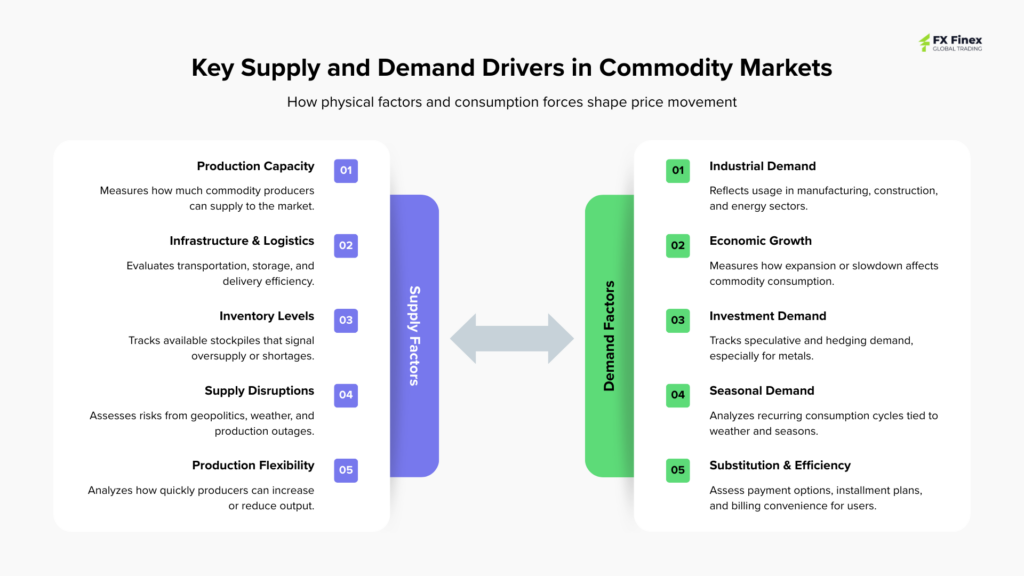
Supply refers to how much of a commodity reaches the market. Production levels depend on extraction capacity, weather conditions, labor availability, and infrastructure. When supply decreases, prices often rise if demand stays constant.
Commodity supply changes slowly compared to financial instruments. New mines, oil fields, or farms require years of investment. This rigidity often leads to prolonged trends once shortages or surpluses develop.
Supply pressure becomes visible through inventory data and production reports. Beginners benefit from watching these metrics instead of short-term price noise.
Note: Slow supply adjustments often lead to extended commodity trends.
Understanding Demand in Commodity Markets
Demand represents how much of a commodity consumers need at current prices. Economic growth increases demand for energy, metals, and agricultural products. Economic slowdowns reduce consumption and pressure prices.
Industrial usage drives demand for copper and oil. Investment demand influences precious metals. Population growth and dietary changes affect agricultural commodities. Each sector responds to different economic signals.
Demand shifts faster than supply. This imbalance often creates volatility. Beginners benefit from identifying whether demand increases or decreases rather than predicting exact price levels.
Demand drivers provide context for price movement. Context improves patience and discipline.
How Supply and Demand Interact
Prices adjust when supply and demand fall out of balance. Excess demand with limited supply pushes prices higher. Excess supply with weak demand forces prices lower until balance returns.
Commodity markets constantly seek equilibrium. When prices rise, producers increase output. When prices fall, production slows. This cycle creates a natural market rhythm.
Oil markets demonstrate this clearly. Production decisions by OPEC affect supply levels, while global economic growth influences demand. Their interaction often creates strong directional trends.
Market balance explains why commodities trend longer than many financial assets.
Inventory Levels and Price Signals
Inventory data shows how much commodity remains available. Rising inventories signal oversupply. Falling inventories suggest tightening markets. Traders monitor stockpile reports to assess balance shifts.
For energy markets, storage levels often predict future price movement. For metals, warehouse data reveals industrial demand strength. For agriculture, seasonal storage patterns guide expectations.
Beginners should view inventories as confirmation tools. They support analysis rather than replacing the price structure.
Inventory insights help beginners interpret market conditions:
- Rising inventories often pressure prices lower
- Falling inventories often support price increases
- Stable inventories suggest balanced markets
Using inventory data improves decision quality. You trade with information instead of emotion.
Tip: Align trades with inventory trends, not headlines.
Seasonal Effects on Supply and Demand
Seasonality plays a major role in commodities. Agricultural products depend on planting and harvest cycles. Energy demand fluctuates with weather patterns and industrial activity.
Seasonal demand peaks often repeat each year. Heating demand rises during winter. Fuel demand increases during travel seasons. These patterns influence price expectations.
Seasonality does not guarantee outcomes. It provides context. Beginners combine seasonal awareness with technical structure to avoid blind assumptions.
Seasonal context improves timing without adding complexity.
Geopolitical and Environmental Impacts
Geopolitical events disrupt supply chains. Conflicts, sanctions, and trade restrictions reduce availability. Environmental factors like droughts, floods, or hurricanes damage production and transportation.
Commodity markets react quickly to these disruptions. Prices often spike before actual shortages occur. This behavior reflects future expectations rather than present conditions.
Beginners should avoid chasing news-driven spikes. Instead, wait for price structure confirmation after initial reactions.
Warning: News-driven price spikes often reverse quickly.
Long-Term Trends Versus Short-Term Fluctuations
Supply and demand influence both long-term and short-term price movements. Long-term trends form when imbalances persist. Short-term moves reflect temporary disruptions or sentiment shifts.
Beginners benefit from identifying the dominant timeframe. Trading against long-term supply constraints increases difficulty. Trading with them improves the probability.
For example, sustained demand growth for metals used in infrastructure often supports multi-year trends. Short pullbacks within trends offer better entry opportunities.
Trend alignment improves consistency and reduces frustration.
Applying Supply and Demand to Trading Decisions
You do not need complex models to use supply and demand. Focus on whether markets tighten or loosen over time. Combine this view with price structure and risk control. Ask simple questions. Is supply increasing or decreasing? Is demand strengthening or weakening? Does price reflect imbalance?
Use these practical steps to apply supply and demand:
- Identify long-term supply constraints
- Monitor demand indicators relevant to the commodity
- Trade in the direction of the confirmed imbalance
These steps keep the analysis grounded. Simplicity improves execution.
Risk Management in Supply Driven Markets
Commodity markets often move sharply when imbalances emerge. Risk management protects capital during unexpected volatility. Beginners benefit from smaller position sizes and wider stops. Always define risk before entering. Accept that supply shocks create unpredictable moves. Survival matters more than catching every opportunity.
Simple risk rules support beginner stability:
- Risk one percent or less per trade
- Avoid multiple correlated commodity positions
- Stop trading after reaching loss limits
Structure limits emotional reactions. Discipline supports learning.
Alert: Ignoring risk during supply shocks leads to rapid losses.
Wrapping Up
Understanding supply and demand in commodities gives beginners a powerful framework for interpreting price movement. Physical constraints, consumption needs, and external shocks shape trends differently from financial markets. Combining this knowledge with discipline and risk control supports steady trading development and long-term confidence.