
Risk management in trading defines how you protect capital while pursuing steady performance across markets. Strong methods reduce emotional pressure and support repeatable decisions. Professional traders treat risk as a daily variable, not a secondary concern.
Successful traders focus on consistency rather than single outcomes. Your account balance reflects thousands of decisions made under pressure. A structured approach helps you control losses, measure exposure, and stay aligned with a long-term plan.
Discipline builds confidence through structure and repetition!
Why Risk Control Shapes Trading Outcomes
Risk control supports survival, which stands above profit goals. Losing streaks occur in every market and timeframe. Traders who plan for drawdowns stay active long enough to benefit from favorable conditions.
Capital protection allows learning through real market feedback. Each trade offers data about execution quality and discipline. Without limits, mistakes grow faster than skills, which leads to early exits from the market.
Note: Always define acceptable loss before entry.
Position Sizing as a Core Skill
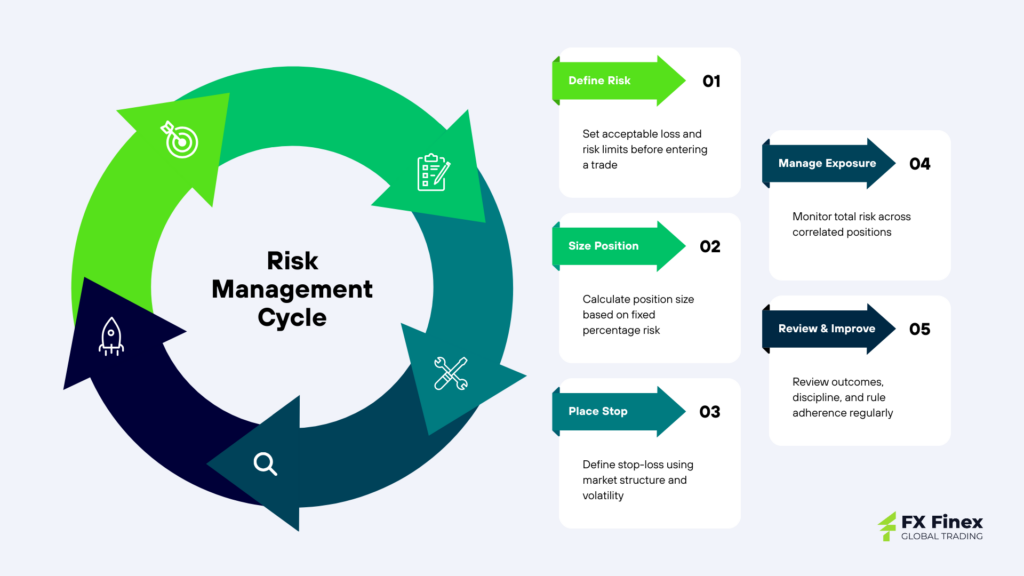
Position sizing determines how much capital enters each trade. This decision affects the volatility of returns more than entry precision. A fixed risk percentage keeps losses predictable across changing market conditions.
Traders often risk between one and two percent per trade. This range balances growth and protection during losing periods. Consistent sizing also simplifies performance review and reduces emotional swings.
These guidelines support balanced exposure decisions:
- Set a fixed percentage risk per trade.
- Adjust size based on stop distance, not opinion.
- Recalculate size after meaningful account changes.
Position sizing aligns each trade with account objectives. When losses stay controlled, confidence improves, and execution quality follows. This structure supports steady improvement through measured repetition.
Tip: Keep sizing rules written and visible during trading.
Stop-Loss Orders and Trade Structure
Stop-loss orders define exit points when the price moves against your idea. They transform uncertainty into a known cost. Professional traders treat stops as part of entry logic, not optional safety nets.
Effective stops reflect market structure rather than arbitrary numbers. Support, resistance, and volatility measures guide placement. Tight stops near noise increase exit frequency and frustration.
Stop placement improves through these practices:
- Place stops beyond technical invalidation levels.
- Avoid moving stops farther from the entry.
- Review the stop effectiveness weekly.
A well-placed stop protects both capital and focus. Clear exits reduce hesitation during fast markets. This clarity supports disciplined execution across different instruments.
Warning: Moving stops after entry often increases losses.
Balancing Reward and Risk
Reward-to-risk ratios frame trade expectations before entry. A common target involves two units of reward for one unit of risk. This structure allows profitability even with moderate win rates.
Planning exits before entry reduces emotional interference. Traders who predefine targets avoid impulsive decisions during price swings. This habit improves consistency and post-trade analysis.
The table below outlines common rewards to risk profiles:
| Reward to Risk | Win Rate Needed | Trading Style Fit |
| 1:1 | 50 percent | High frequency |
| 2:1 | 34 percent | Balanced approach |
| 3:1 | 25 percent | Trend focused |
Reward planning guides trade selection and patience. When setups fail to meet criteria, disciplined traders stand aside. This restraint protects capital during unclear conditions.
Alert: Favor quality setups over frequent trades.
Managing Risk Across Multiple Positions
Portfolio risk considers the combined exposure from open trades. Correlated instruments amplify losses during adverse moves. Traders monitor total risk rather than individual positions alone.
Diversification across assets and strategies reduces concentration. This approach smooths equity curves and lowers emotional stress. Clear limits on total exposure prevent overtrading during strong conviction periods.
Practical portfolio rules include:
- Limit total open risk to a fixed percentage.
- Avoid stacking trades in correlated markets.
- Review exposure before adding new positions.
Portfolio awareness strengthens long-term stability. When markets shift suddenly, controlled exposure preserves decision-making capacity. This mindset supports professional behavior under pressure.
Notice: Correlation increases during high volatility events.
Psychological Discipline and Execution
Risk rules fail without consistent execution. Emotional responses often appear after losses or rapid gains. Traders who follow written plans reduce impulsive behavior and protect long-term objectives.
Journaling supports accountability and pattern recognition. Reviewing emotional states alongside results reveals performance leaks. This practice strengthens discipline and supports continuous improvement.
Midway through your development, risk management in trading becomes a behavioral skill rather than a technical one. Mastery reflects habit strength, not indicator choice.
Wrapping Up
Risk management in trading defines longevity and performance quality. Structured position sizing, disciplined stops, and portfolio awareness protect capital through changing conditions. When rules guide every decision, confidence grows, and results stabilize over time.